
A Leading Sustainability-Focused University in Bahrain: Gulf University’s Vision 2030 Strategy
Bahrain’s Vision 2030 is no longer a distant ambition — it is an active national agenda shaping how institutions, businesses, and universities operate in the Kingdom. This shift is placing real pressure on higher education to contribute meaningfully to sustainable development.
As a sustainability-focused university in Bahrain, Gulf University has responded with a structured and measurable sustainability strategy.
Over the past several years, the university has been building a sustainability framework that runs deeper than policy statements and annual reports. It touches on how the campus is powered, how research is directed, how students spend their time, and increasingly, where Gulf University graduates end up working after they leave.
So what does that actually look like in practice? Let us get into it.
Why Sustainability and Bahrain Vision 2030 Education Align
Bahrain Vision 2030 sets out three broad pillars for the Kingdom’s future:
- a sustainable environment,
- a competitive economy, and
- a fair society.
None of those three things happen without educated people who understand what sustainability demands of them professionally and personally.
That is where universities become critical.
A student who studies inside an institution that takes sustainability seriously comes out of that experience with something that cannot be taught in a single lecture. They develop an instinct for it.
They see it in the decisions being made around them, in the research being produced by their faculty, in the campus infrastructure they use every day, and in the community programmes running alongside their studies.
Gulf University has been deliberately building that kind of environment. And the results are starting to show in ways that matter.
In the last few academic years, more than 16% of Gulf University graduates moved directly into sustainability-related employment — roles in ESG analysis, environmental law, sustainability accounting, and green infrastructure. That number has grown every year for three consecutive years.
You do not get that kind of outcome by writing the Bahrain Vision 2030 education policy. You get it by building a culture.
Embedding all SDGs across the curriculum
The United Nations Sustainable Development Goals give institutions a global framework to measure themselves against.
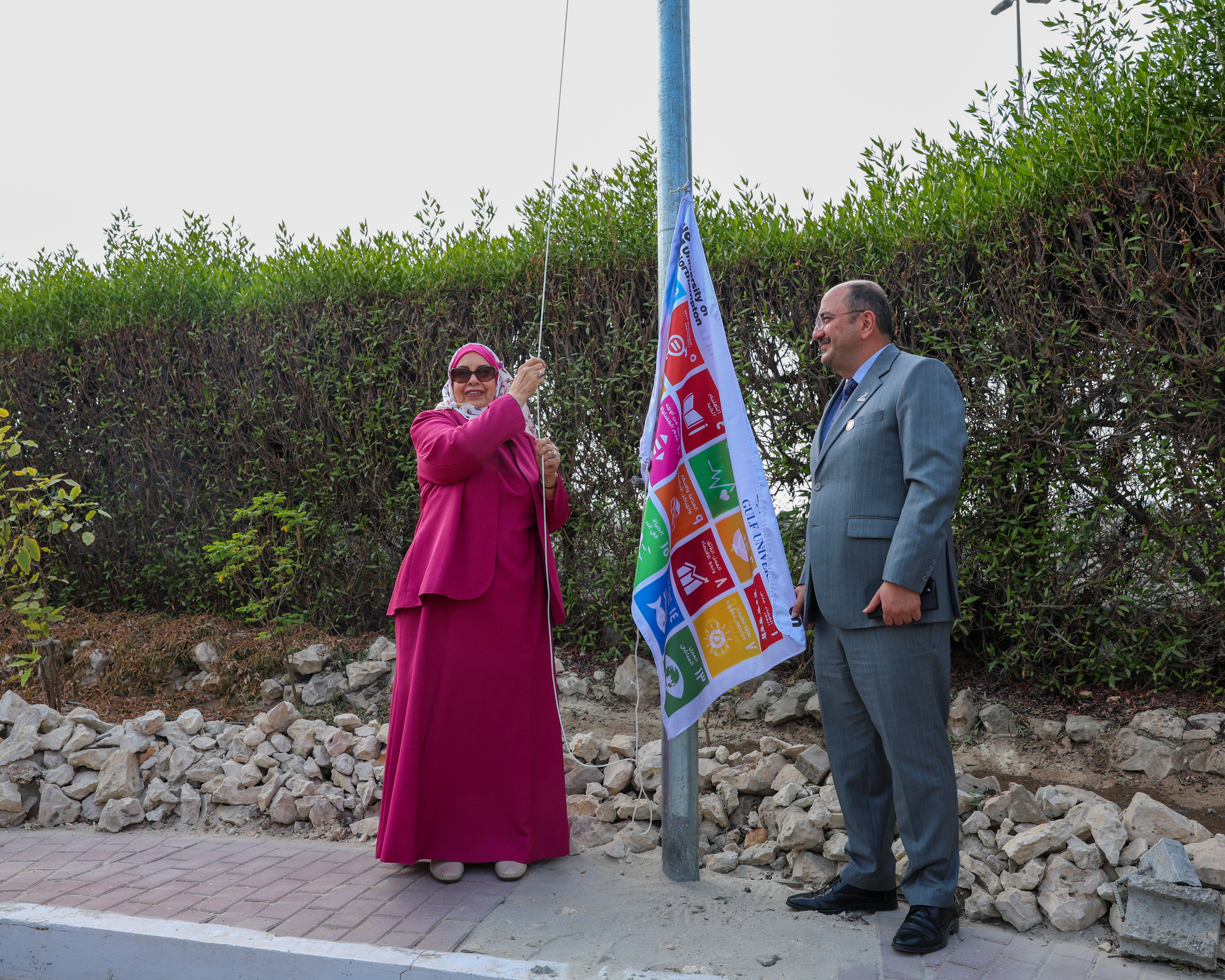
All 17 of them. From No Poverty and Zero Hunger to Climate Action, Life Below Water, and Partnerships for the Goals.
Gulf University has formally aligned its programmes, research, and community work across all 17 SDGs. This represents a significant institutional commitment. It means every college, every research centre, and every community engagement programme has to account for how it connects to the broader global sustainability agenda.
And the university is not doing this quietly. It publishes an annual Sustainability Report, documents its performance against each SDG, and is continuously ranked in international sustainability rankings, including UI GreenMetric and the THE Impact Rankings. External scrutiny, not internal self-assessment.
Creating Impact Through Sustainability Week
Once a year, Gulf University dedicates a full week to sustainability as a concentrated institutional moment. The week itself runs for five days and fills them properly.
- There are seminars and debates on climate policy alongside student project showcases.
- Moreover, the University organises awareness campaigns and workshops on clean energy and responsible consumption.
- Faculty present research, while the students demonstrate innovation projects they have been working on through the semester.
- Last but not least, there are community engagement sessions that bring the entire university together around one shared focus.
GU’s Sustainability Week is not about lecturing on sustainability; it is a platform to showcase ongoing impact. It is more like making its sustainability work visible all at once, but that work is just displayed in these five days.
Gulf University focuses on teaching real lessons throughout the year, with activities such as:
- Tree-planting drives across campus and community sites, with hundreds of trees planted annually
- Beach cleanup campaigns that connect environmental awareness to Bahrain’s coastal ecosystem
- Health and wellbeing outreach run in partnership with hospitals, clinics, and the Ministry of Health
- Student innovation projects in areas like smart irrigation, waste reduction, and renewable energy design
- Workshops and training sessions covering climate action, responsible consumption, gender equality, and civic responsibility
- Community donations and humanitarian programmes including meal distribution, computer donations, and support for vulnerable groups
The Sustainability and Development Makers Center, known as SDM-C, coordinates much of this work year-round. It is the institutional engine that keeps sustainability from becoming a seasonal conversation.
What Gulf University Is Building Into the Curriculum
Sustainability is not a standalone subject at Gulf University. It is woven into how programmes across all colleges are designed and delivered.
- A third of all courses at the university now incorporate sustainability themes in some form.
- Faculty are producing research connected to real environmental and social challenges facing Bahrain and the wider region.
- And the Community Engagement and Continuing Education Centre runs outreach programmes that take the university’s expertise beyond the campus and into the communities around it.
This matters for students in a practical sense. The professional world they are entering expects sustainability literacy. Employers across the Gulf are increasingly looking for graduates who understand ESG frameworks, climate risk, ethical governance, and responsible resource management. Gulf University is building those competencies into the degree, not leaving them to chance.
The Policy Framework Behind the Practice
One of the clearest signals of institutional seriousness is the depth of the policy framework an institution is willing to put in writing and make publicly accountable.
Developing a genuinely green campus in the GCC is harder than it sounds. The climate alone pushes against it. Gulf University has done it anyway and has published more than 25 sustainability-related policies. These cover a wide range of commitments including:
- Climate change and greenhouse gas emissions reduction
- Clean energy technology development
- Plastic waste and marine pollution reduction
- Water reuse and sustainable procurement
- Gender pay equity and non-discrimination
- Disability access and workers’ rights
- Ethical sourcing for food and supplies
- Whistleblower protection and staff grievance procedures
These are not internal documents. They are publicly available on the university’s website, which means anyone, including students, employers, partner institutions, and government bodies, can read them and hold the university to account for them.
That level of transparency is a sustainability practice.
A Green Campus Model in the GCC
Spend a day on the Sanad campus and you start to understand why the green campus GCC conversation keeps coming back to Gulf University.
- Smart building systems cover the entire built area of the campus.
- Energy-efficient appliances account for the vast majority of campus equipment.
- Solar panels are generating a growing share of the university’s energy needs.
- An AI-powered irrigation system manages landscape water use with a precision that manual systems cannot match.
- Recycled water is used for campus greenery.
- Waste is segregated and managed through certified disposal partnerships.
Together, these systems position the campus as a practical model for sustainable infrastructure in the GCC.
The campus is, in the language of sustainability education, a living laboratory. Students can see the principles they are studying being applied in the physical environment around them. That connection between theory and practice is exactly what genuine sustainability education requires.
Gulf University is Playing a BIG Role in Bahrain’s Sustainable Future
Gulf University’s sustainability initiative is not a finished project. It is a direction the institution has committed to and is building on year by year.
The university has set out plans to expand its renewable energy footprint, deepen research collaboration with regional and international sustainability partners, extend its community outreach programmes, and strengthen the connection between its academic work and the national policy priorities of Bahrain Vision 2030.
For students considering Gulf University, all of this is relevant in a direct and practical way.
The institution you study in shapes how you think. It shapes what you notice, what you value, and what you consider normal professional behaviour. A university that treats sustainability as a genuine institutional responsibility is giving its students something that goes beyond the degree transcript.
So, if you are looking for a sustainability Bahrain university story that goes beyond solar panels and recycling bins, Gulf University is not simply adapting to sustainability trends — it is actively shaping how higher education contributes to Bahrain’s sustainable future.
Keywords: Bahrain Vision 2030 education, sustainability-focused university in Bahrain, Gulf University sustainability initiatives, UN Sustainable Development Goals (SDGs) in education, green campus GCC universities
Last Updated: 04 Aug 2026